
Work Salary portability
02 · Scale
One card, +73%.
One card added to a context screen lifted conversion in Itaú’s salary portability journey by 73%, and won the bank’s internal award for the most impactful journey of the year.
- Role
- Group Design Manager
- Organization
- Itaú Unibanco
- Team
- 8 product and service designers
- Recognition
- 1st place · Shared Experience Awards
01 Why this journey
The journey a retail bank cannot afford to lose.
Salary portability is one of the highest-value journeys a retail bank has. When someone’s income lands in your account, almost every other relationship follows it: credit, investments, cards, insurance.
The journey already had a competent context screen: an image, a promise, a list of benefits, a call to action. Nothing about it was broken. That is exactly what makes this kind of gain hard to find.
02 The change
A card that named the customer’s actual situation.
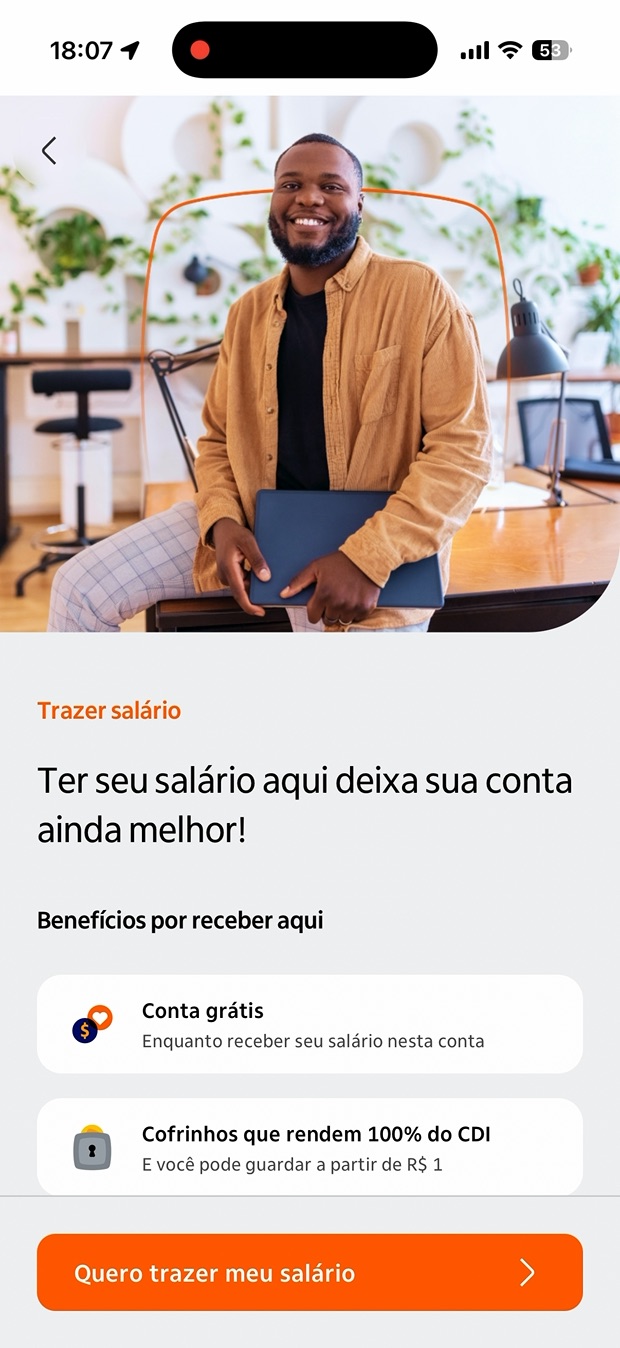
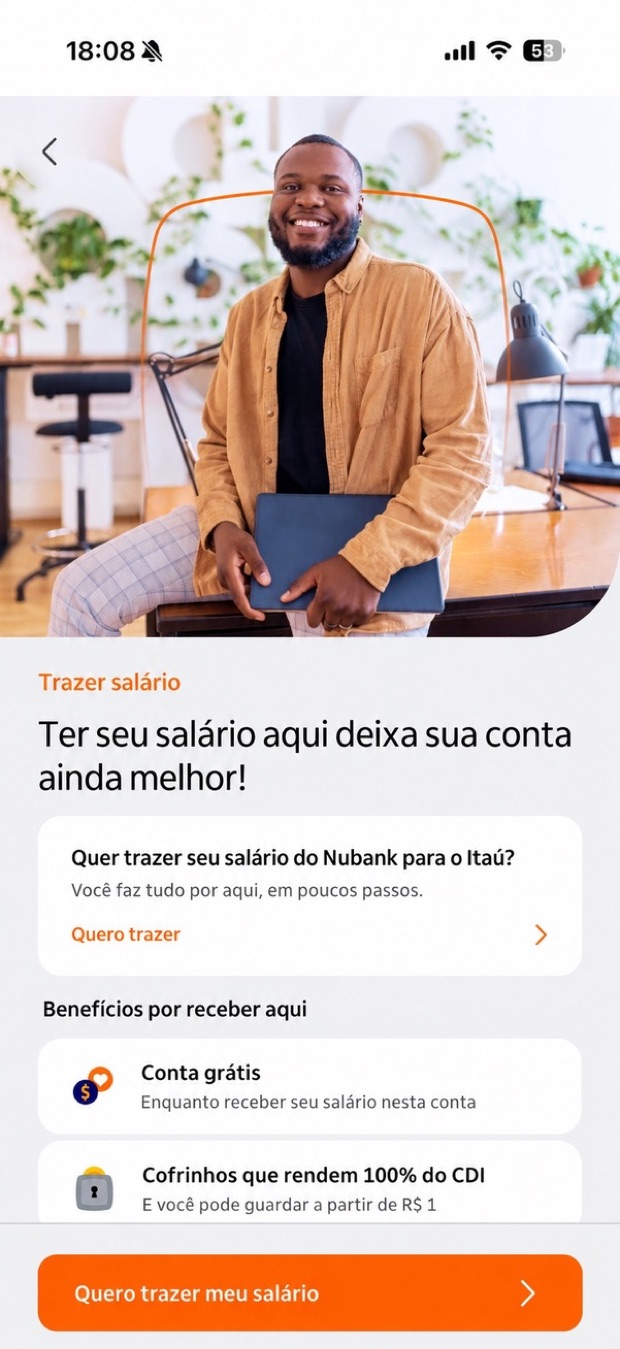
On that same screen we added a card that said the thing nobody was saying, which is that the customer probably had a salary sitting at another bank. It invited them to bring it across and stated what they would gain by doing it.
Open finance made the route short enough that the invitation was credible. Suggesting a move you cannot make easily is just an advert; suggesting one that takes a few taps is a product.
- Before
- After: one card added
Results
conversion in the salary portability journey
Shared Experience Awards, most impactful journey for customer and business
03 Why it worked
The screen was never the problem.
A benefits list answers why should I. It does not answer is this about me. The card answered the second question, and it answered it before the benefits rather than after them. That order is the whole intervention.
It also arrived at the moment the customer was already looking. No new traffic, no new campaign, no new screen. One card, one position in the reading order.
04 The lesson
Innovation is not always a revolution.
Small moves can produce large results, quickly. This one changed a single position in a reading order and moved a number the whole bank watches.
That is worth saying out loud in a portfolio, because the opposite belief is expensive: teams wait for the big rebuild while the fastest available gain sits one card away.
05 How I ran it
I looked for the cheapest place to change the result.
We could have redesigned the whole journey. Redesigning a live, high volume flow costs quarters and puts the conversion you already have at risk. So I sent the team looking for a smaller change with a bigger return.
-
I read the funnel before anyone touched a screen
The question I asked was not which screen is worst. It was which step loses the most people relative to how cheap it is to change. Those are two different screens, and only the second one is worth a quarter of the team's time.
-
I named the client's situation instead of the product
The card we added names something the client already knows, which is that their salary is sitting at another bank. It does not describe a feature. People do not act on capabilities. They act on a description of their own circumstances.
-
I put the benefit at the moment of the decision
We chose the context screen because that is where the client is already weighing whether this is worth doing. The same message one screen earlier is advertising. At that point it is information.
-
I changed one thing so we could tell what worked
We added a single card. That is why the movement in conversion could be read as a consequence rather than a coincidence. A redesign that changes fifteen things teaches you nothing about any of them.
Innovation is not always a revolution. The discipline is choosing where a small move has the steepest return, and changing little enough that you can still prove what caused it.